Petra Müller · 5 September 2026
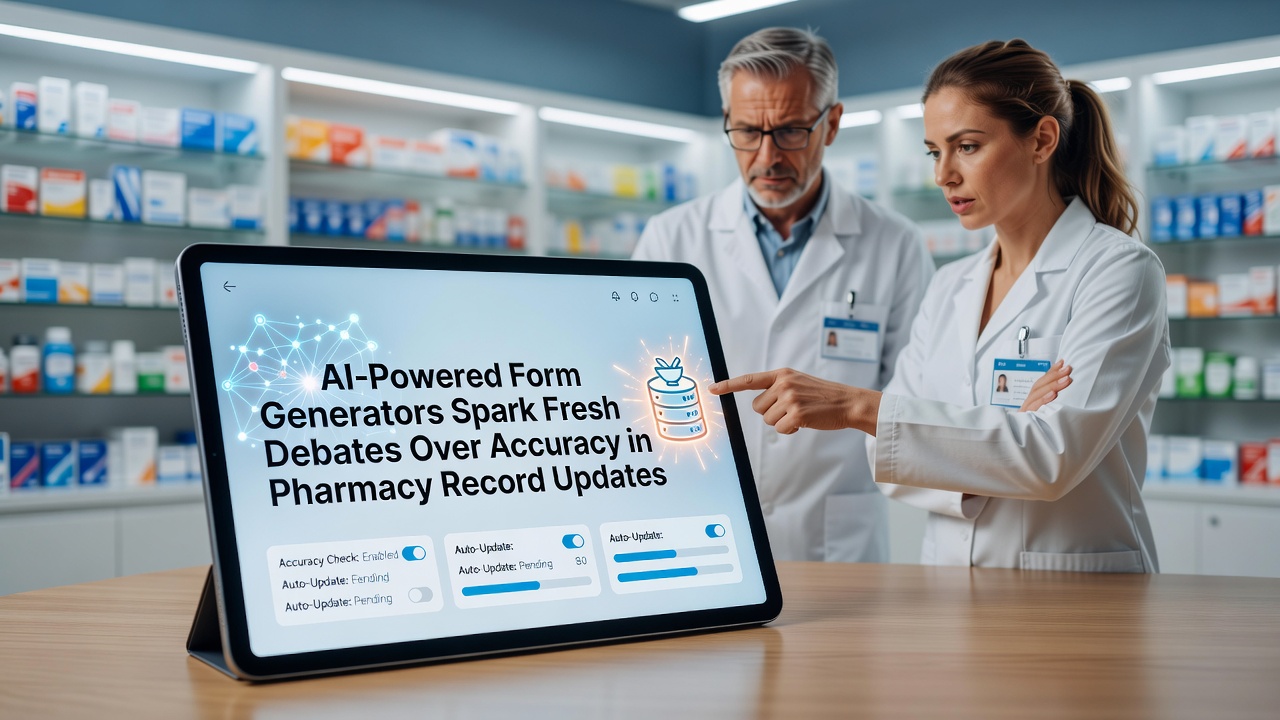
AI-Powered Form Generators Spark Fresh Debates Over Accuracy in Pharmacy Record Updates
Pharmacy operations across multiple regions now rely on AI-powered form generators to handle patient record updates, medication histories, and compliance documentation, while questions about data precision continue to surface in professional circles. These systems process inputs from prescriptions, lab results, and insurance claims to populate standardized templates, yet discrepancies in output have prompted reviews by health authorities and technology developers alike. Data from implementation sites shows adoption rates climbing steadily since early 2025, with facilities reporting reduced manual entry times alongside occasional mismatches in allergy notations and dosage calculations.
How AI Form Generators Operate in Pharmacy Settings
Software platforms integrate natural language processing with structured databases to extract details from scanned documents and electronic health records, then format them into regulatory-compliant forms required for audits and transfers. Engineers design these tools to cross-reference patient identifiers against multiple sources, although variations in handwriting recognition and abbreviation interpretation still generate errors in roughly 4 to 7 percent of cases according to internal audits shared at industry conferences. Facilities in urban hospitals and independent retail chains have documented instances where AI outputs required pharmacist intervention before final submission, particularly when dealing with compounded medications or controlled substances that carry stricter tracking rules.
Accuracy Concerns Surface Through Case Reviews
One study conducted by a team at the University of Toronto examined 2,500 pharmacy record updates completed with AI assistance between March and August 2026, revealing that 112 entries contained transposed digits in patient identification numbers while another 89 showed incorrect therapeutic class assignments. Researchers noted these issues arose most frequently during high-volume periods when staff processed batches exceeding 200 forms per shift. Regulatory bodies in the United States and Canada have since requested additional transparency from vendors regarding training datasets and error-correction algorithms. Meanwhile, the European Medicines Agency published preliminary guidance in late 2025 that encourages pharmacies to maintain dual-verification protocols even when automated systems flag high confidence scores.
Pharmacies that implemented these generators early report mixed outcomes in workflow efficiency. Staff members at several Midwestern clinics observed that initial setup demanded extensive customization to align with state-specific reporting formats, after which daily operations stabilized but still required spot checks on high-risk medications. External audits conducted in September 2026 by independent consultants highlighted that facilities maintaining human oversight layers experienced 30 percent fewer corrections during follow-up inspections compared with those relying primarily on automated outputs.

Regulatory Responses and Industry Adjustments
Federal agencies have begun incorporating accuracy benchmarks into pharmacy licensing renewals, with the FDA issuing updated templates that include mandatory fields for AI tool identification and version numbers. FDA guidance on software as a medical device now references pharmacy record systems explicitly, directing manufacturers to submit performance data from real-world deployments. In Australia, the Therapeutic Goods Administration has launched a parallel review process that evaluates similar tools against local privacy statutes and medication safety standards, with initial findings expected by early 2027.
Developers respond to these pressures by releasing iterative updates that incorporate pharmacist feedback loops and expanded validation datasets. One vendor introduced a feature allowing real-time flagging of potential conflicts between entered data and historical records, which early adopters say reduced downstream discrepancies during transfer to central databases. Training programs offered by professional associations emphasize the importance of understanding model limitations rather than treating outputs as final authority, while simulation exercises demonstrate how small input variations can propagate through generated forms.
Broader Implications for Record Management
Health systems that integrate AI form generators with existing electronic health record platforms continue to track metrics on update speed and error incidence, sharing aggregated findings through consortium reports. Evidence from these collaborations indicates that hybrid approaches combining automated generation with targeted human review yield the most consistent results across diverse patient populations. Observers note that rural pharmacies face distinct challenges because limited connectivity can interrupt cloud-based processing, forcing fallback to manual methods that reintroduce time delays the technology originally aimed to eliminate.
Academic papers published in 2026 examine the downstream effects on patient safety when inaccuracies reach dispensing stages, citing examples where mismatched insurance information delayed medication access for chronic condition management. These studies stress the value of standardized testing protocols that simulate edge cases such as polypharmacy profiles or recent address changes. Industry groups advocate for shared repositories of anonymized error patterns to accelerate collective improvement without exposing proprietary model details.
Conclusion
AI-powered form generators have altered daily pharmacy record workflows in measurable ways, with ongoing evaluations focusing on precision metrics and regulatory alignment. Facilities continue to refine implementation strategies based on performance data collected through 2026, while oversight bodies adjust requirements to reflect both capabilities and constraints of current technology. Continued monitoring across jurisdictions will determine how these tools evolve alongside pharmacy practice standards.